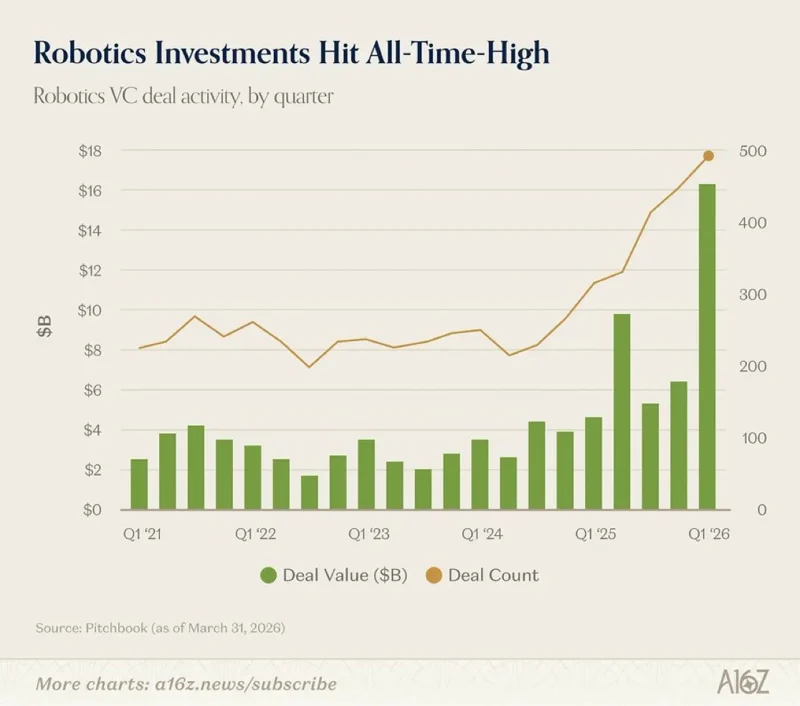
It appears the venture capital crowd has collectively decided that sentient baristas and autonomous warehouse droids are the new fintech darlings. In the first quarter of 2026, investors poured an eye-watering $16.3 billion into robotics and “physical AI” startups across 492 deals. According to new data from Pitchbook, highlighted by the heavyweights at Andreessen Horowitz (a16z), this isn’t just a funding bump; it’s a full-throttle vertical ascent. We are witnessing a massive capital rotation away from pure-play software and into the tangible, world-altering realm of hardware.
To put that figure into perspective, this single quarter’s feeding frenzy represents roughly 4.5 times the deal value and double the deal count of the average quarter between 2021 and 2025. This deluge of cash has catapulted robotics from a niche category that barely moved the needle in 2016 to the second-largest heavyweight in the private markets, unceremoniously knocking fintech and payments off their long-held throne. The surge was bolstered by massive “megadeals” for firms like Shield AI, Saronic, and Neura Robotics.
Why does this matter?
This isn’t just VCs chasing the latest shiny bauble. It’s a strategic gamble on what a16z calls the “rotation to atoms.” For decades, the industry mantra was “software is eating the world,” and VCs chased asset-light, high-margin business models. Now, the smart money is betting that the next trillion-pound opportunities lie in hardware unlocked by sophisticated software. The logic is elegant: AI is the ultimate key for robotics, evolving machines from performing repetitive factory drudgery to solving complex, real-world problems in defence, logistics, and, eventually, our own living rooms.
Is this just another bubble waiting to burst? With nearly 500 deals inked in a single quarter, the investment is broad-based, rather than being concentrated in a handful of over-hyped humanoid projects. However, industry veterans are already sounding the alarm regarding “hardware tourists”—investors new to the scene who might be underestimating the brutal, soul-crushing difficulty of building and scaling physical products. While the long-term shift towards automation is clear, the road ahead will likely be littered with mangled prototypes and burnt-through cash. For now, the VCs have placed their chips, and they aren’t on another food delivery app. They’re betting on atoms, and they’re betting the house.