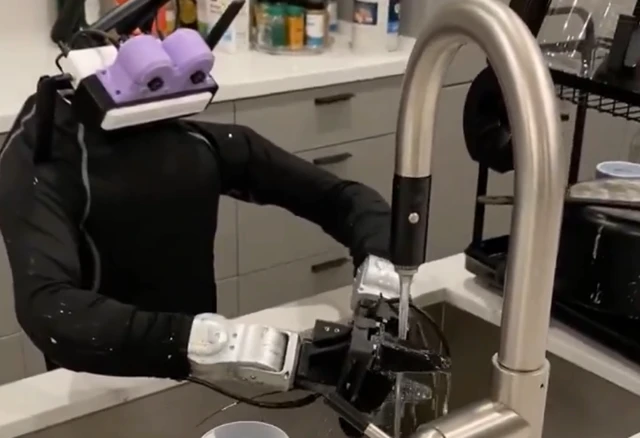
In a move that feels plucked straight from a sci-fi flick, yet is remarkably pragmatic, startup Tau Robotics has begun rolling out a humanoid-powered cleaning service in San Francisco for the frankly astonishing price of just $30 an hour. The service, currently operating on an invite-only basis, promises to tackle your domestic chaos with a bipedal bot that vacuums, washes dishes, and tidies up, all under the watchful gaze of a remote human operator.
Now, let’s not get ahead of ourselves; this isn’t full autonomy just yet. The key to Tau’s seemingly baffling price point—a figure that utterly trounces many human cleaning services in the notoriously pricey Bay Area—is its “human-in-the-loop” model. Each robot functions as a telepresence avatar, “jointly controlled by a human operator and AI,” as founder Alexander Koch explains. The robot’s head unit, which bears a striking resemblance to a high-end router, complete with binocular cameras, is evidently optimised for a human to remotely observe and manipulate objects. This ingenious approach neatly sidesteps the fiendishly tricky problem of creating a fully autonomous agent that can navigate the endless mayhem of a typical human home.
Videos released by the company show the humanoid performing tasks like vacuuming and carefully washing dishes, all at a perfectly normal pace. The motions appear wonderfully fluid, a direct upshot of the human pilot. Make no mistake: this isn’t about a robot deciding to scrub the sink; it’s about a human wielding a sophisticated, bipedal tool to get the job done from miles away.
Why is this important?
Tau Robotics’ strategy is a rather brilliant sidestep in the frantic race for full autonomy. While competitors pour billions into cracking the nut of general-purpose AI, Tau is deploying hardware right now by keeping humans firmly in the driver’s seat. This model serves two critical functions: it not only generates revenue immediately but, crucially, it forges a massive, real-world data-gathering pipeline. Every hour a human operates a Tau robot, they are generating invaluable training data that can be leveraged to incrementally boost the AI’s contribution, slowly but surely dialling back the need for constant human supervision. It’s a “Wizard of Oz” approach to robotics that could allow Tau to attain practical autonomy through sheer iteration, while its rivals are still tinkering away in the lab. For $30 an hour, San Franciscans on the waitlist aren’t just getting their floors vacuumed; they’re essentially paying to be the inaugural citizens of our teleoperated future.