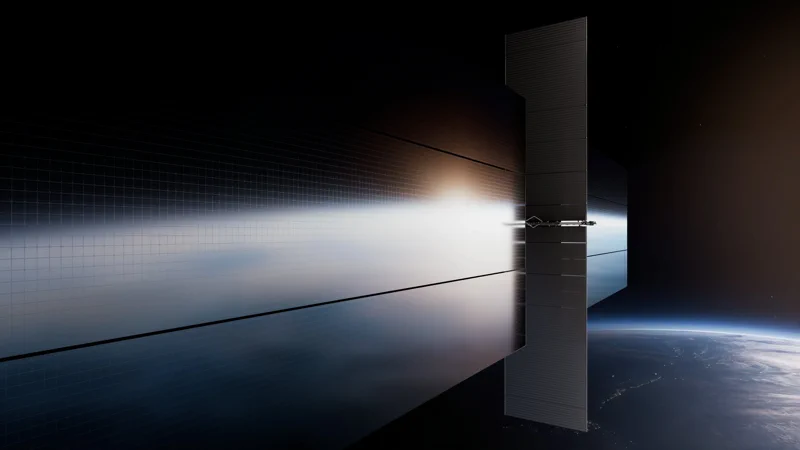
Just as we were beginning to wrap our heads around the sheer scale of terrestrial data centres, SpaceX has decided to take the “cloud” literally. The company has unveiled Starmind, a breathtakingly ambitious plan to hoist an AI supercomputer into the heavens, and it’s teaming up with Nvidia to provide the muscle. Each Starmind satellite is designed to act as a “datacenter-class orbital compute” node, kitted out with Nvidia’s next-generation—and still largely under wraps—Rubin GPUs and Vera CPUs.
The reveal, which dropped just ahead of SpaceX’s first earnings call as a public entity, marks a strategic pivot that recasts the aerospace titan as a heavyweight in AI infrastructure. The Starmind AI1, the flagship of this planned constellation, is a true behemoth. It boasts a projected wingspan of 75 metres (roughly 246 ft) and a compute payload capable of pulling up to 250 kW of peak power from its sprawling solar arrays. SpaceX intends to mass-produce these orbital data centres at a new “Gigasat” facility in Texas, with the first deployments slated for as early as 2027.
Why does this matter?
This isn’t merely about finding a new home for servers; it’s a strategic masterstroke regarding energy and thermal efficiency. Terrestrial data centres are increasingly hamstrung by power grid constraints, land-use disputes, and the staggering amount of water required for cooling. SpaceX’s logic is refreshingly blunt: why grapple with Earth-bound headaches when you have constant solar energy and the vacuum of space acting as a free, hyper-efficient heat sink? By radiating heat directly into the void, Starmind could bypass the energy-intensive cooling systems that currently account for a massive chunk of overhead at ground-based sites.
Naturally, latency remains the elephant in the room. This orbital supercomputer is likely destined for “heavy lifting”—massive, asynchronous AI training tasks—rather than the real-time applications that demand split-second responses. However, for training the next generation of foundation models, offloading the colossal computational burden to an orbital platform powered by free energy could be a total game-changer. It’s a vintage Musk manoeuvre: leveraging SpaceX’s core knack for reaching orbit affordably to disrupt an entirely different, and incredibly lucrative, sector. For Nvidia, it’s another massive win, locking in a futuristic client for a hardware platform that hasn’t even hit the shelves yet.