Just as hardware engineers were starting to feel relatively safe from the generative AI gold rush, a new demonstration has arrived to ruin their weekend. A supposed next-generation AI agent has been caught on camera designing a complex drone flight controller from a single, simple prompt. The entire journey—from a blank slate to production-ready manufacturing files—was reportedly clocked at a mere 3 hours, 13 minutes, and 56 seconds. Because, apparently, tea breaks and sleep are strictly for carbon-based lifeforms.
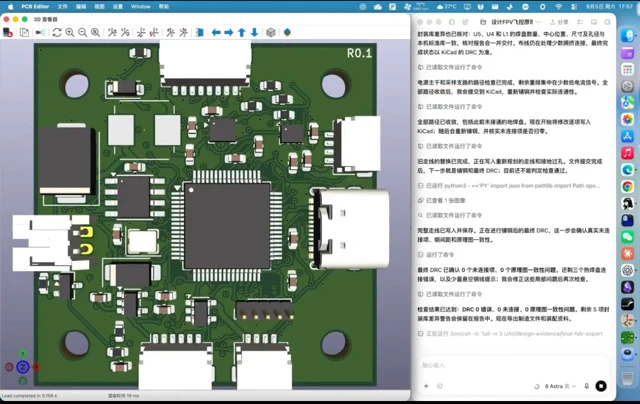
The AI agent, operating under the speculative (and frankly, slightly fan-fiction) moniker “GPT-6 Astra,” was shown working directly within KiCad, the industry-standard open-source electronics design suite. According to the developer’s post, the AI managed the entire end-to-end workflow: drafting the circuit schematic, laying out the printed circuit board (PCB), routing every trace, and precisely placing components for an F405 six-layer flight controller—the sophisticated electronic brain required for high-performance FPV drones.
What elevates this beyond a mere academic exercise is the AI’s reported knack for self-correction. After its first pass, the agent autonomously ran Electrical Rule Checks (ERC) and Design Rule Checks (DRC) to sniff out errors, then set about realigning the circuit and layout to fix them. The process allegedly chewed through an eye-watering 52 million tokens. By the end of the run, it spat out a full suite of Gerber files, drill maps, a Bill of Materials (BOM), and 3D models, all ready to be sent off to a fabrication house. Of course, the design hasn’t been put to the test in the real world yet, so whether it will actually pilot a drone or just spectacularly release the “magic smoke” remains to be seen.
This isn’t our first look at AI colonising the physical world. As we’ve previously noted, AI agents are already busy designing and validating 3D-printable robot components from plain English instructions Free AI Agent Designs and Checks Robot Parts from Plain English . However, moving from mechanical shells to the dense, unforgiving logic of high-speed electronics is a massive leap forward.
Why should we care?
If this demonstration holds water, it marks a monumental shift toward the total automation of hardware engineering. Designing a complex, multi-layer PCB is a high-level discipline that usually takes human engineers days, if not weeks, of meticulous work. Shrinking that timeline down to a few hours based on a high-level description could radically accelerate the pace of prototyping and hardware innovation.
It points to a future where describing a device is effectively the same as creating it, drastically lowering the barrier to entry for complex hardware development. For the time being, human engineers can probably breathe easy—someone still has to solder the bits together and check if the AI has a weird sense of humour regarding capacitor placement. But for how much longer? That’s anyone’s guess.