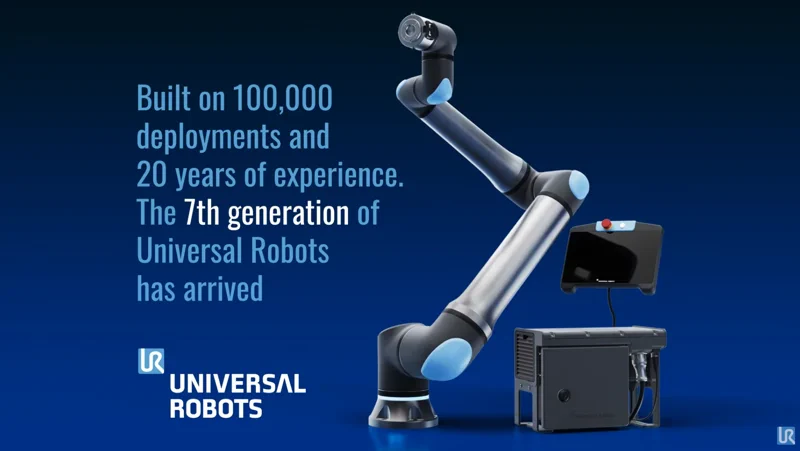
Universal Robots, the firm that arguably kickstarted the entire collaborative robot movement, has pulled the curtain back on its first major platform overhaul in years. Unveiled at the IMTS trade show in Chicago, the new Gen 7 platform is a ground-up redesign aimed squarely at the next frontier of manufacturing: transforming “physical AI” from a high-concept lab experiment into a practical factory-floor reality. Building on a legacy of over 100,000 cobot deployments, UR is betting that ease of use remains king, even as the tasks themselves become infinitely more sophisticated.
The launch introduces the new “g-Series” family of robot arms, a streamlined controller, and a fresh operating system—all engineered to bin the integration headaches that usually plague AI-driven automation. “The robots of the AI era must be advanced, not complicated,” noted Jean-Pierre Hathout, President of Universal Robots’ parent company, Teradyne Robotics.
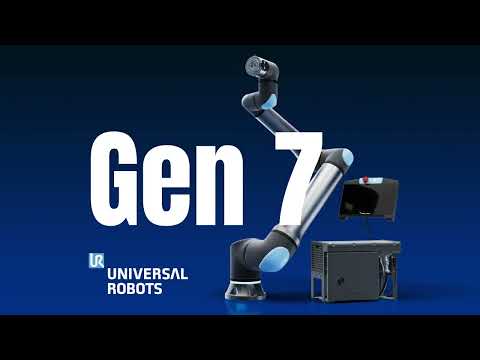
At the heart of the Gen 7 platform are some seriously impressive hardware upgrades designed to cut out the clutter. The new CB7 Core controller manages to cram 40% more compute power into a footprint that’s 30% smaller—a godsend for anyone managing a cramped production line. More importantly, the new g-Series arms feature an “AI-ready” tool flange that integrates power (24/48V), high-speed data (1Gb Ethernet), and safety I/O directly at the wrist. For anyone who has ever faffed about with a “dress kit” of external cables for a vision system, this is a massive quality-of-life win that provides the high-bandwidth connectivity needed for real-time AI.
The software side of things sees a similar focus on opening up the ecosystem. The new PolyScope X operating system offers native support for ROS 2, the open-source framework that is essentially the lingua franca for robotics researchers and developers. This, paired with open APIs, is a clear invitation for the AI community to build applications directly onto UR’s kit, shifting their creations from the research lab to live production lines. Partners like Inbolt are already showing off vision systems that run natively on the new controller, ditching the need for a separate, bulky external PC.
Why does this matter?
Universal Robots hasn’t just built a beefier or faster robot arm; it has tackled the primary bottleneck holding back intelligent automation: system integration. By tidying up the physical cabling at the tool, embedding more processing grunt, and embracing open standards like ROS 2, the Gen 7 platform significantly lowers the barrier to entry for complex AI applications.
It’s a savvy strategic play to defend its market-leading position—UR currently holds roughly 40% of the cobot market—as the industry moves away from simple “pick and place” tasks toward more dynamic, perception-heavy work. Universal Robots is positioning its platform not just as a tool, but as the fundamental infrastructure for the next generation of physical AI, hoping to make deploying a neural network as straightforward as programming a simple waypoint.