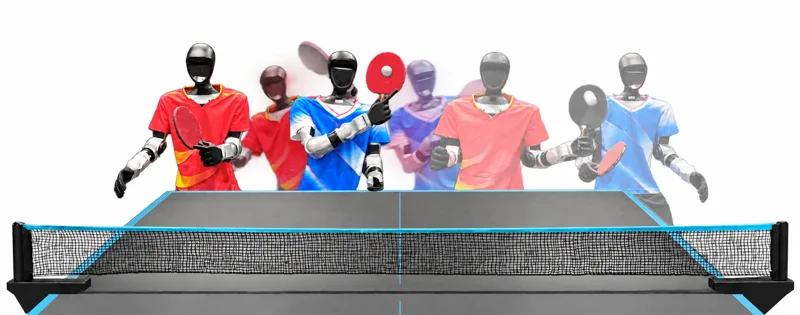
Teaching a humanoid robot to master table tennis is a classic benchmark for high-speed control. But teaching two of them to play doubles? That’s an entirely different kettle of fish. It’s less about landing a killer topspin and more about ensuring you don’t trip over your multi-thousand-pound partner. Researchers from Archon Robotics, NVIDIA, The University of Hong Kong, and the Shanghai Innovation Institute have choreographed this chaotic dance with a new system dubbed PingpongDuo. In real-world trials, a pair of Unitree G1 humanoids managed to sustain rallies of over 10 consecutive shots, all while (mostly) staying out of each other’s way.
The real headache in doubles isn’t the ball-striking; it’s the frantic repositioning within a cramped space. Teammates have to strike in strict alternation, meaning the second one robot hits the ball, it has less than two seconds to clear the deck for its partner. A moment’s hesitation and you’ve got a collision between two 35kg machines—turning a friendly match into a very expensive heap of actuators and bruised pride. PingpongDuo solves this via a hierarchical framework detailed in a paper now on arXiv. At the team level, a planner picks positioning targets and employs a “risk filter” to veto any movement that looks like it might end in a friendly-fire incident.
On an individual level, the robots juggle separate skills for footwork and striking, honed using motion data from human doubles players. The system is ruthlessly efficient: one robot was clocked performing a 2.15-metre clearance-and-recovery manoeuvre in a mere 2.4 seconds, hitting a top speed of 2.23 m/s. In simulations, PingpongDuo boosted the ball-return success rate by 13.2% compared to previous state-of-the-art singles-playing robots. You can catch the robots in action on the official project page.
Why does this matter?
This isn’t just a warm-up for an all-robot Olympics. It’s a serious deep dive into dynamic, safe coordination for multiple robots sharing the same physical space. The AI framework that stops two humanoids from clattering into each other during a fast-paced game is easily translatable to complex warehouse logistics, collaborative assembly lines, or any scenario where autonomous systems need to work cheek-by-jowl without causing metallic carnage. For Archon Robotics, it’s a stellar showcase for their “Whole-Body Intelligence” platform, proving they can manage not just a single robot’s balance, but the collective flow of a team.