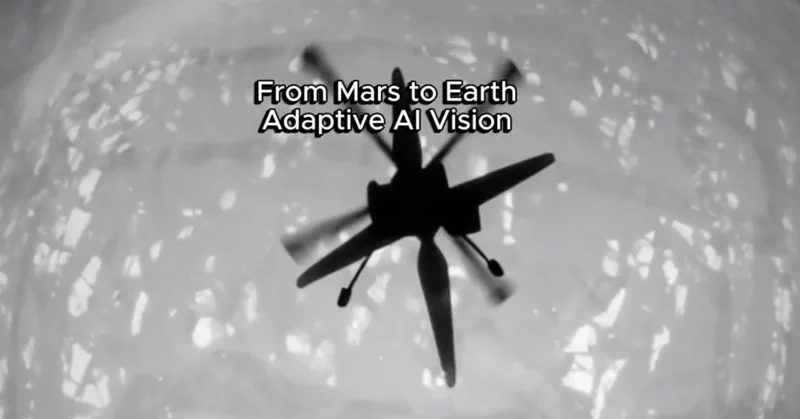
AstraQua, the startup spearheaded by Loay Elbasyouni—the lead electrical engineer who helped the history-making Ingenuity Mars Helicopter take flight—has just landed a £1 million ($1,274,990) Phase II contract from NASA. But don’t expect them to be tinkering with your Roomba’s existential dread; instead, they’re teaching machines a form of high-stakes self-preservation dubbed “operational self-awareness.”
The tech in question, AstraSense, is a far cry from your car’s vague “check engine” light. Rather than just pinging a binary error code, it allows a system to diagnose its own hardware degradation in real-time and, crucially, reason about what it can still safely achieve. It’s the mechanical equivalent of a hiker realising they’ve tweaked a hamstring and deciding to limp home carefully rather than attempting a summit sprint. As CEO Loay Elbasyouni puts it: “A robot should know when to slow down, not just when it has broken down.”
This NASA Small Business Innovation Research (SBIR) contract is initially laser-focused on electric and hybrid-electric aircraft propulsion—a cornerstone of the agency’s Advanced Air Mobility (AAM) ambitions. If autonomous flying taxis are ever going to be more than a sci-fi pipe dream, they’ll need a level of reliability that borders on the paranoid. A system that can intelligently pivot around a failing component, rather than simply giving up the ghost mid-air, isn’t just a “nice-to-have”—it’s a non-negotiable. This Phase II win follows a successful Phase I stint that proved the core diagnostic logic actually holds water.
Why does this matter?
This research strikes at the very heart of a major hurdle in robotics: the shift from brittle automation to resilient, adaptable autonomy. Most of today’s robots operate within rigid failure parameters where a single glitch can scupper an entire mission.
AstraQua’s approach promises machines capable of “graceful degradation”—adjusting their flight paths or workloads based on a nuanced, “gut-level” understanding of their own physical health. While NASA’s futuristic fleet is the immediate beneficiary, the ripple effects for industrial cobots, long-range delivery drones, and the next generation of Martian explorers are massive. It’s a foundational step towards building autonomous systems we can actually trust when things, inevitably, start to go a bit pear-shaped.