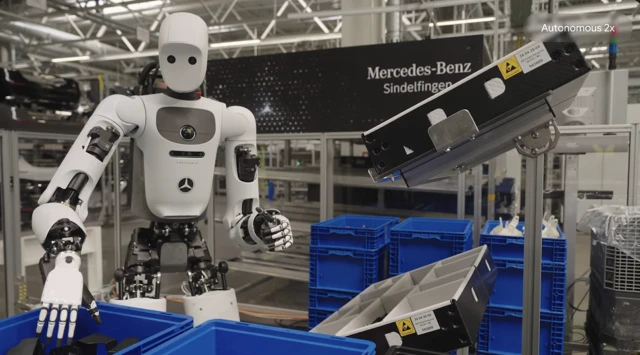
Google DeepMind has just turned the heat up on industrial automation. On 10 November, the tech titan unveiled Gemini Robotics 2.5, its latest vision-language-action (VLA) model, and it’s already clocking in for its first shift. In a pilot scheme that likely has factory floor managers leaning in with interest, the new AI is currently powering Apptronik’s Apollo humanoids on the production lines of Mercedes-Benz.
The standout figure from this heavy-metal partnership is a 96% success rate in a real-world automotive kitting task. Deployed at Mercedes-Benz plants in Sindelfingen, Germany, and Kecskemét, Hungary, the Apollo robots—running Gemini 2.5—were tasked with picking metal brackets from bulk bins and placing them into sequencing trays for the assembly line. This isn’t some sanitised lab demo; it’s a rigorous proof-of-concept on an active production line for one of the world’s most exacting carmakers. According to DeepMind, the new model offers a 30% to 100% higher success rate and is 20% to 30% faster across more than 200 tested tasks compared to its predecessors.
The Apollo humanoid itself is a 5ft 8in, 73kg piece of engineering designed to operate in spaces built for people, capable of lifting payloads up to 25kg. The Mercedes-Benz pilot actually employs a clever “two-brain” approach: a Gemini Robotics ER (Embodied Reasoning) model manages the high-level workflow, while Gemini Robotics 2.5 handles the delicate fine motor control for the arms and hands. DeepMind also highlighted significant safety gains, noting that new guidance capabilities improved safe task completion by 33% around obstacles and 43% when working alongside human colleagues.
Why does this matter?
This is more than just another robot on a factory floor. It represents a high-stakes clash of titans, pitting Google’s AI intellect against rivals in the sprint to create a viable, general-purpose humanoid workforce. While others are busy polishing their highlight reels, Google, Apptronik, and Mercedes-Benz are stress-testing their solution on a live, high-end production line.
That 96% success rate is a serious benchmark, but as DeepMind is quick to admit, “the road from 96% to 99.9999% is going to be steep.” That final 4%—the dropped brackets or slightly misaligned placements—is the notoriously difficult “last mile” between a promising pilot and a truly scalable, “lights-out” manufacturing solution. Nevertheless, by deploying a humanoid that can learn and adapt rather than just follow a rigid, pre-written script, this collaboration marks a massive stride towards a future where robots don’t just automate simple tasks, but navigate the messy, variable reality of complex industrial work.