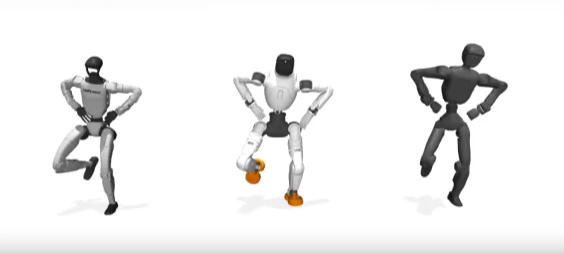
Training a new AI controller for every bespoke robot frame is one of the most tedious and prohibitively expensive chores in modern robotics. However, researchers from Caltech and Georgia Tech are aiming to kill off the “one-bot-one-brain” era with MorphMimic. This single, shared AI policy is designed to pilot humanoids with wildly different physiques, allowing robots as diverse as the Unitree G1, AgiBot X2 Ultra, and Booster T2 to pull from a massive library of 128,786 motion clips using the exact same set of neural network weights.
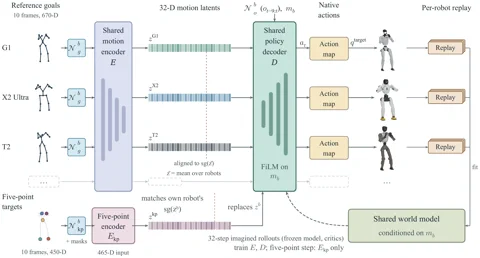
The secret sauce behind MorphMimic is its ability to grok and adapt to a robot’s physical form—its morphology. Building on the foundations of SuperMimic—a high-speed training method where robots “practice” within a learned, differentiable world model—MorphMimic takes things a step further. It begins by mapping every robot’s joints onto a “canonical layout,” effectively creating a universal language for movement.
From there, a 125-value descriptor detailing the robot’s specific actuation, geometry, and mass is fed into the shared policy network. This descriptor essentially whispers to the AI: “You’re behind the wheel of a lanky, top-heavy bot with high-torque knees today,” allowing it to calibrate the perfect motor commands for that specific chassis. For those who want to poke around under the bonnet, the project’s code is available in a public GitHub repository.
Why this matters
This research signals a pivotal shift from bespoke, single-robot controllers to generalist AI “brains” that can be hot-swapped into new hardware. Instead of engineers having to go back to square one for every new prototype, a single, robust policy can be adapted to a fresh robot simply by plugging in its physical specs.
As detailed in the research paper, this unified model, trained across three distinct robots, performs almost as flawlessly as specialist models trained on each one individually. It’s a massive leap toward a future where robot “skills” are as portable as a smartphone app, finally freeing hardware designers to innovate without the constant headache of rewriting the entire control stack from scratch.