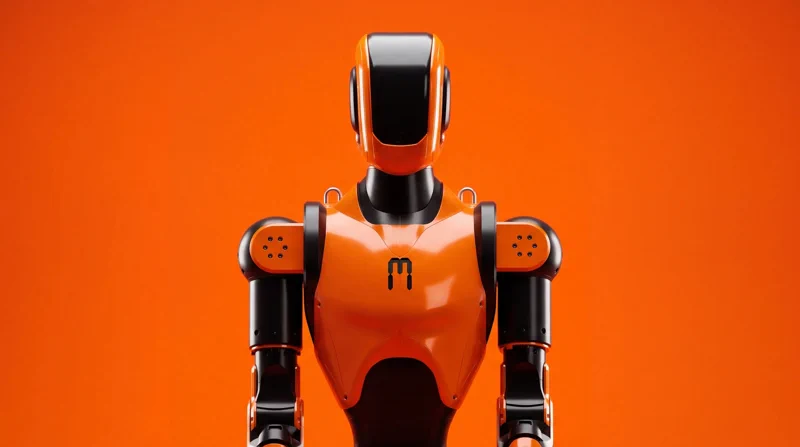
If you’ve ever looked at a polished humanoid robot from the likes of Boston Dynamics or 1X and thought, “I could do that, if only I had a spare clean room and a venture-backed budget,” then Singapore-based Menlo AI has a proposition for you. It’s called the Asimov 1, and for the same $20,000 price tag as a pre-ordered 1X Neo, it offers a completely different vision of the future. Instead of a sleek, autonomous butler, you get a collection of parts in a box.
This is the IKEA flat-pack of bipedal robotics, complete with a bill of materials that will make your credit card sweat and an instruction manual for a build estimated to take over 100 hours. It’s a bold, almost absurdly nerdy counter-pitch in a world obsessed with turnkey solutions. And it just might be brilliant.
Your Next 100-Hour Project
Let’s be clear: the Asimov 1 is not a toy. This is a serious research platform masquerading as the world’s most complex LEGO set. Standing 1.2 meters tall and weighing 35 kg, its frame is a mix of CNC-milled 7075 aluminum for critical load-bearing structures and Multi Jet Fusion PA12 nylon for everything else. This isn’t some wobbly, 3D-printed hobby project; it’s engineered for repeatability and robustness.
The robot features 25 powered joints plus two passive, spring-loaded toe joints, giving it a total of 27 degrees of freedom. This allows for some respectable, if not world-beating, performance metrics: a 5 kg squat, 18 kg lateral raises per arm, and a walking speed of 3 km/h with a two-hour battery life.
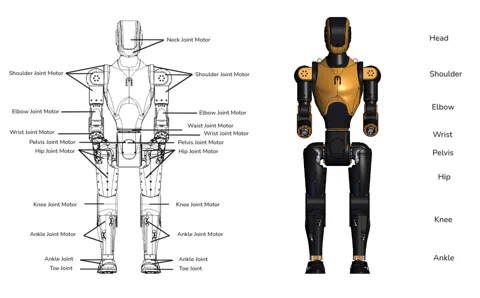
Running the show is a clever dual-computer setup. A Raspberry Pi 5 handles the high-level tasks—networking, audio, and processing data from its 2MP monocular camera and microphone array—while a more specialized Radxa CM5 board manages the hard real-time motor control. It’s a pragmatic design choice that prioritizes accessibility and cost-effectiveness over exotic, proprietary hardware.
An Open Platform in a Closed World
The core philosophy of Asimov 1 is radical transparency. While most robotics companies guard their designs like state secrets, Menlo AI has published everything on GitHub—the CAD files, wiring schematics, and the complete Bill of Materials (BOM). You don’t even have to buy the $20,000 kit; you could, in theory, source every single nut, bolt, and actuator yourself, though the company notes their bulk pricing saves builders around $11,000 compared to sourcing parts one-by-one.
This openness directly addresses a common frustration in the research community. When a user on X asked why they shouldn’t just buy a 1X Neo, the company’s response was telling.
Asimov Inc (the account for the project) elaborated on this philosophy:
“It’s a robot you can make your own. We believe thousands of builders can make better robots together if someone hands them an open foundation. That is what Asimov 1 is here for.”
This brings us to the most glaring omission: the robot has no hands. This isn’t an oversight; it’s a statement. Menlo AI is providing the platform, the legs, the torso, the brain—the foundational elements of humanoid locomotion and control. It’s up to the global community of builders and researchers to decide what it does with that platform. It’s a Bring-Your-Own-End-Effector party, and everyone is invited.
A Tale of Two $20,000 Humanoids
The contrast with the 1X Neo couldn’t be starker. Both platforms have a $20,000 price tag, but they represent two fundamentally different futures.
- 1X Neo: A polished, consumer-facing appliance. It arrives fully assembled, ready to (eventually) perform household tasks. It is significantly stronger, capable of lifting up to 70 kg, but operates as a “black box.” You are a user of their platform.
- Asimov 1: A transparent, developer-focused kit. It arrives in pieces, demanding significant technical skill to assemble. Its capabilities are more modest, but every aspect is open to modification and inspection. You are a builder on their platform.
This isn’t a competition; it’s a bifurcation of the market. The Neo is for those who want the service a humanoid can provide, while the Asimov 1 is for those who want to define what that service can be.
The open-source approach could act as a powerful accelerator for the entire field. By providing a common, affordable, and robust hardware baseline, Menlo AI is creating a standardized platform for researchers to test new AI models and control policies. Instead of reinventing the bipedal wheel, labs can now focus on the brain, the software, and the applications. The future of robotics may not be forged in a single, secretive corporate lab, but rather assembled, debugged, and improved in a thousand different garages and universities worldwide.